秀米
China’s youth turn to immersive disaster simulations to learn survival skills_我的网站

一 |
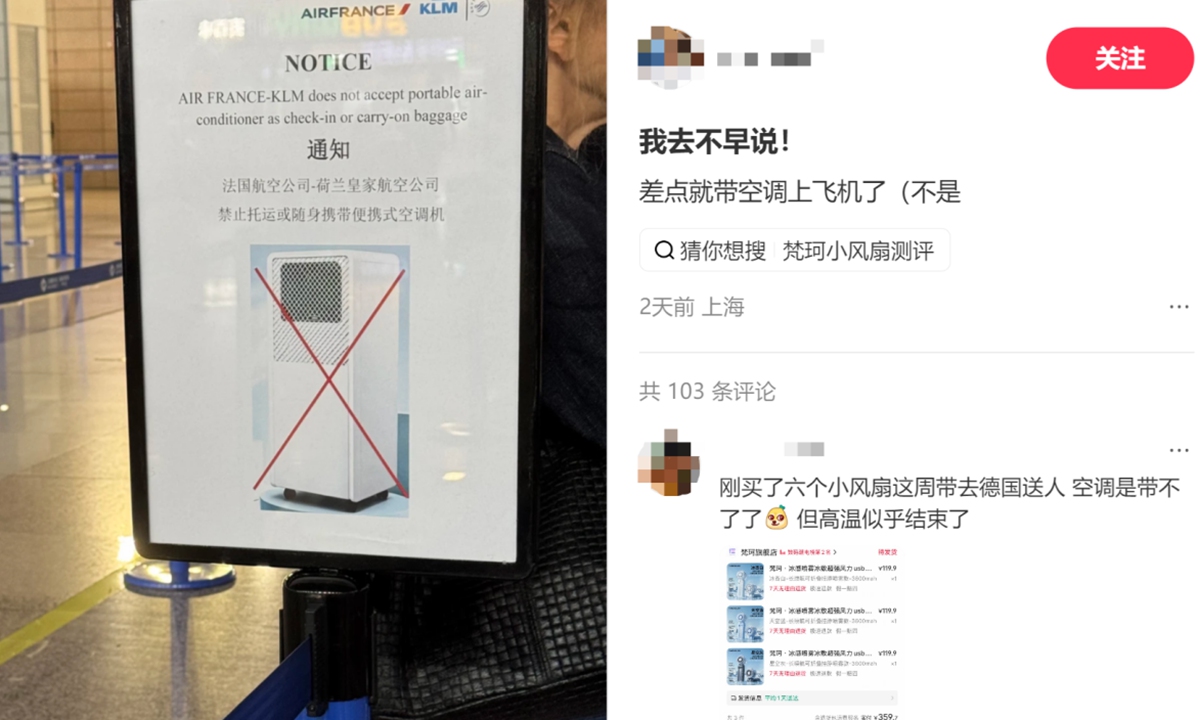
A notice at a check point at Shanghai Pudong International Airport that says "Air France-KLM does not accept portable air-conditioners as checked or carry-on baggage. Photo: Screenshot from website
A Rednote post recently sparked discussion and jokes among netizens after showing a notice stating that "Air France-KLM does not accept portable air conditioners as checked or carry-on baggage," against the backdrop of extreme heatwaves in Europe this summer and the difficulty of securing one in European markets.
Air France-KLM customer service later confirmed to the Global Times on Monday that the restriction was in place, explaining that passengers' baggage must comply with relevant rules and requirements, which are established based on operational and safety considerations.
The discussion came as Europe has been hit by persistent extreme heat in recent months, triggered widespread heat alerts and a surge in local demand for air conditioners, a product that was not widely installed in European households.
After the RedNote post was released, some netizens shared similar experiences in the comments section, with one writing: "I just bought six small fans to take to Germany as gifts, [now that] Air conditioners are out of the question. But it seems the heatwave is finally over."
Some speculated that the sign was put up after travelers to Europe tried to imitate a widely reported case in which a Chinese employee based in Shanghai helped a French colleague visiting China on a business trip bring an air conditioner from China back to Europe by air in July.
The story was shared by the Chinese employee on RedNote. After researching different models, the Chinese selected a compact unit suitable for international transport based on its size and weight. The air conditioner reportedly used non-flammable R410A refrigerant, with a refrigerant charge of 350 grams, and contained no lithium battery. According to the post, the netizen concluded that the unit could be transported as regular baggage transport rather than being treated as dangerous goods.
The netizen also carefully consulted the ICAO technical instructions and IATA dangerous goods regulations to determine whether the air conditioner needed to be handled as dangerous goods, per the post.
The French colleague, with sufficient baggage allowance, only paid for additional packing services. The total cost came to 1,412 yuan ($209.26), including 1,260 yuan for the air conditioner, 130 yuan for airport packaging, and 22 yuan for a high-power European power adapter.
The French passenger was reportedly transported the air conditioner successfully and arrived in Barcelona.
However, airlines have reminded passengers that while some air conditioners may qualify for checked baggage, strict requirements still apply.
Battery and refrigerant restrictions must be followed, as portable air conditioners containing lithium batteries are strictly prohibited from being checked in. Meanwhile, size and weight limits must be considered as the equipment must comply with airline baggage allowances, which typically limit individual pieces to 23 kilograms or 32 kilograms, and total dimensions generally not exceeding 158 centimeters.
Professional packaging is also recommended, with travelers advised to use airport packing services to reduce the risk of damage during baggage handling.
Experts said that as Europe continues adapting to increasingly frequent heatwaves, the unusual trend of travelers carrying cooling equipment across borders highlights growing concerns over climate extremes, while also serving as a reminder that aviation safety rules remain a key consideration for transporting household appliances.
In second quarter of 2026, China-Europe freight trains have transported more than 100,000 portable air conditioners and key components, with a total cargo value of about $52 million, helping to ease supply pressures in the European market, according to a report by China Railway Group media.
。
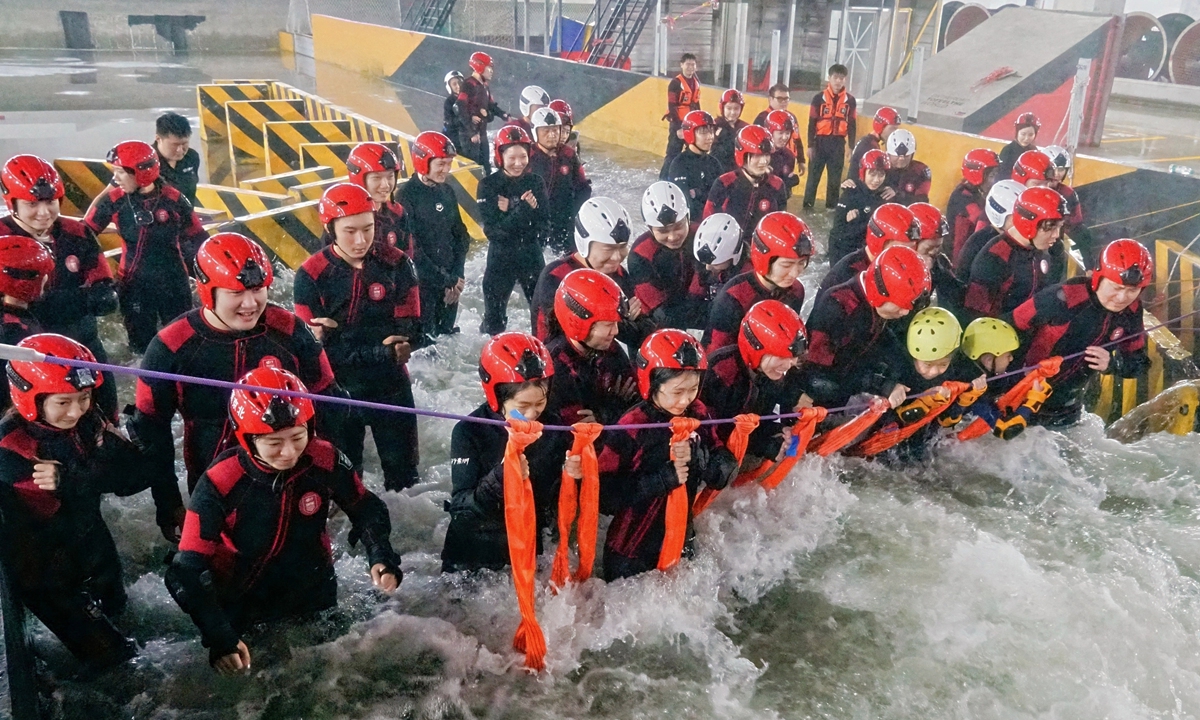
Photo: Courtesy of Lvxing Disaster Simulation Training CenterWhat would you do if you were trapped in an underground parking garage that is being flooded?
As heavy rain associated with Typhoon Dolphin continued to affect large parts of China, an increasing number of people were turning to immersive disaster simulations to experience extreme weather scenarios in a controlled environment at the Lvxing Disaster Simulation Training Center in Hangzhou, East China's Zhejiang Province.
At the country's first natural disaster simulation venue, adult participants pay 899 yuan ($133) per person to virtually confront situations such as typhoons, urban flooding and sudden flash floods, to gain a sense of what such emergencies might feel like.
Wang Kuanghan, operator of the training center, told the Global Times that the center is designed to allow people to experience the dangers of natural disasters in a safe and controlled environment, while raising awareness of the need to respect nature and avoid potential risks.
"We hope to pass on the experience we gained from encountering natural disasters during our years of traveling around the world," Wang said. "Beyond teaching people how to respond when natural disasters strike, what is more important is cultivating an awareness of how to avoid risks."
As of July, the center had received more than 70,000 visits this year for hands-on experiences, including tourists as well as companies and professional rescue teams that come for training. The number is higher than the same period in 2025, he noted.
Fu Minya, a Hangzhou-based office worker, told the Global Times that she has heard of the center and would like to give it a try.
"The frequent news reports of natural disasters in recent weeks have reminded people of how small and vulnerable we are in the face of nature's forces," she said.
After Typhoon Dolphin made landfall in China in early August, its remnant impact brought downpours to several provinces. Chinese authorities previously earmarked 80 million yuan to support flood and geological disaster relief efforts in the Central China's Henan and Hubei provinces and East China's Anhui Province, the Xinhua News Agency reported.
The flash flood simulation is one of the most intense experiences the center offers. Participants stand in a simulated river channel as an instructor presses a button, releasing around 500 tons of water from above. Within just three seconds, many participants are knocked off their feet, left tumbling in the rushing water and being swept toward the protective wall at the end of the channel.
"Real flash floods move even faster," said Wang. "When the water rises above knee level, it is almost impossible for an adult to remain standing. Many people instinctively think they should swim to escape, but that can be fatal."
Flash floods carry mud, branches and rocks that can quickly entangle your arms and legs. The right thing to do is to watch for warning signs of an impending flash flood, move away from the riverbank before the flash flood occurs, and quickly evacuate to higher ground on either side, he said.
In another exercise, several participants slog ahead holding each other's arms as the facility simulates winds reaching speeds of up to 165 kilometers per hour, as well as torrential rain.
However, there are concerns that simulated disasters could trivialize the suffering of disaster victims and turn the trauma of real-life disasters into entertainment.
This is a promising new niche in urban cultural tourism, Yu Jinlong, a Beijing-based cultural scholar, told the Global Times on Wednesday.
By striking the right balance between entertainment and public education while strictly adhering to safety protocols, such facilities can become more than just viral check-in destinations; they can serve as a replicable platform for public emergency education, Yu noted.
In the past, disaster-prevention education largely relied on display boards and lectures, which often made it difficult for people to develop an intuitive understanding of the dangers involved, Yu said.
Real-life simulations, by contrast, allow participants to experience firsthand the destructive force of typhoons and flash floods, turning abstract knowledge into tangible memories. This is where such facilities can offer unique social value, making them particularly suitable for educational programs for young people and emergency-response training for businesses and institutions, he said.
The experience can be impactful, but it should not be reduced to a sensationalist spectacle. Only by combining immersive experiences with practical self-rescue training and maintaining strict safety standards can this emerging model continue to serve as a meaningful platform for public disaster-prevention education, Yu noted.
Statistics show that 95 percent of people rescued from natural disasters survive through self-rescue, Wang said. "If you are swept away by water or hit by strong winds here, you will develop a much deeper understanding of how to respond to hazards and protect yourself."
。
Current article:http://2xtat.ruidunguizanpaorangchongouxia.sbs/news/20260826_508.html
Published on:00:00:00
 微信
微信 移动端
移动端


